
Point cloud surveys create a measurable 3D record of an existing building or site. We capture the physical geometry with professional laser scanning equipment and deliver registered point cloud data that can be used directly for measurement, design coordination, CAD drawings and Revit/BIM workflows.
Detailed spatial record of visible geometry.
A reliable measured reference for downstream design work.
Point cloud only, or conversion into drawings and models.
Residential, commercial and complex buildings.
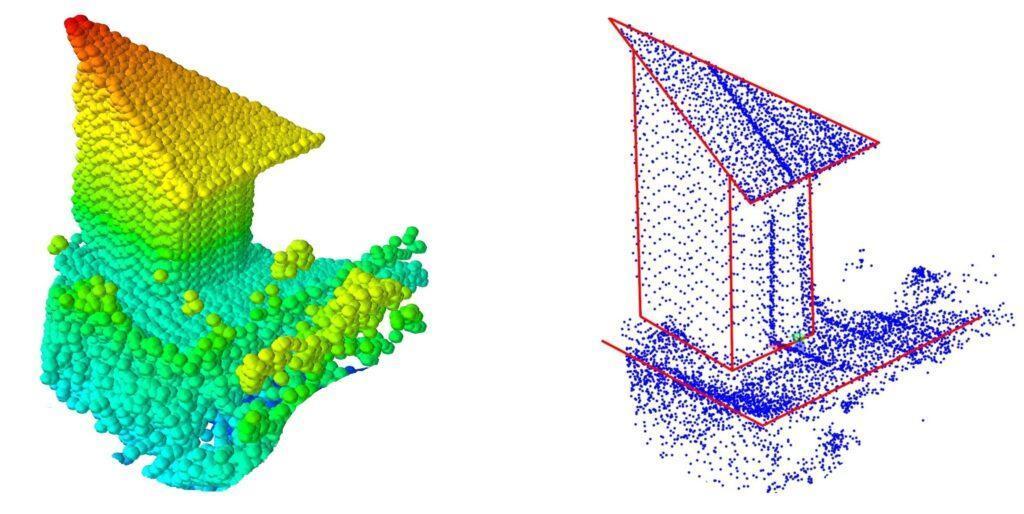
A point cloud survey is the capture and registration stage. A laser scanner records millions of XYZ measurements from multiple positions and those scans are aligned into a single coordinated dataset. The resulting point cloud can be measured and reviewed directly, or used as the source for floor plans, elevations, sections, CAD drawings and BIM/Revit models.
Choose a point cloud survey when you need a detailed digital record of existing conditions but do not necessarily need every drawing or model produced immediately.
What Do You Receive from a Point Cloud Survey?
The correct deliverable depends on what you intend to do with the data. Some clients need the registered point cloud itself; others use the survey as the measurement source for a complete drawing or BIM package.
Registered point cloud
A unified 3D dataset produced from multiple scan positions and aligned into one project coordinate system.
2D CAD drawings
Floor plans, elevations and sections can be extracted from the survey when a drawing package is required.
Revit / BIM model
The point cloud can be used as the measured reference for model creation and design coordination.
Point Cloud Survey vs Measured Building Survey
These services overlap, but the main deliverable is different. A point cloud survey is usually chosen when the registered 3D dataset itself is required. A measured building survey is usually chosen when the project team needs finished drawings or a model as the principal deliverable.
Point cloud survey
You receive a registered 3D record of visible existing conditions that can be measured, reviewed and used later for CAD, Revit or coordination work.
Measured building survey
The survey is taken through to finished outputs such as floor plans, elevations, sections or a building model. The point cloud may still be the measurement source behind those deliverables.
When Is a Point Cloud Survey the Right Choice?
Refurbishment & retrofit
Capture existing geometry before design work begins, particularly where old drawings are incomplete, inconsistent or unavailable.
Complex buildings
Useful where irregular walls, roof geometry, staircases, structural features or dense internal spaces make selective manual measurement inefficient.
Architectural design
Provide architects and designers with an accurate spatial reference that can be interrogated later without repeatedly returning to site for basic dimensions.
As-built documentation
Create a digital record of visible existing conditions for coordination, verification and future drawing production.
CAD & BIM workflows
Use the registered cloud as the measurement source for plans, elevations, sections, Revit models or other design outputs.
Heritage & detailed geometry
Laser scanning can preserve a dense record of visible features that would be difficult to capture reliably with isolated manual dimensions.
How Does a Point Cloud Survey Work?
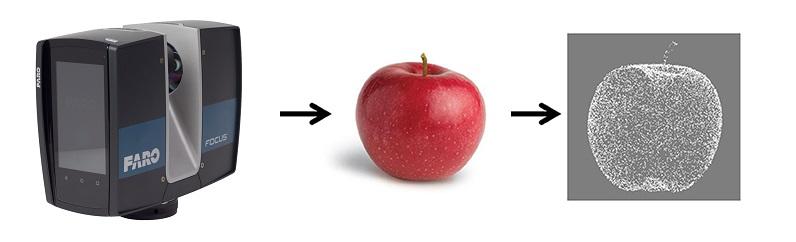
A laser scanner measures the distance and direction to visible surfaces and stores each measurement as a point in three-dimensional space. A single scanner position cannot see through walls, furniture, columns or other obstructions, so a complete survey normally requires multiple scan positions. Those scans are then registered together to form one master dataset.
What Can a Point Cloud Survey Capture?
A point cloud is strongest when the required geometry is visible and accessible. It provides a dense spatial record of surfaces the scanner can see, but it is not an X-ray and should not be treated as one.
Visible existing geometry
- Walls, floors, ceilings and roof geometry visible from the survey positions.
- Openings, columns, stairs and other visible architectural features.
- External elevations and accessible site features included in the agreed scope.
- Irregular or complex geometry that is difficult to record efficiently with isolated manual dimensions.
Hidden or inaccessible information
- Geometry concealed behind closed walls, ceilings, fixed furniture or inaccessible areas.
- Internal services or structural elements that are not physically visible.
- Areas excluded from access during the site visit.
- Critical details not visible from the agreed scanner positions.
Occupied properties can often still be surveyed, but clear access and visibility improve coverage and efficiency. If a particular room, facade, service zone or architectural feature is critical, tell us before the survey so the capture strategy can be planned around it.
Point Cloud Accuracy, Density and Survey Specification
There is no single setting that is ideal for every project. The useful specification is the one that matches the purpose of the survey. Capturing more points does not automatically make a project better if the required geometry, registration quality, site control and final deliverables have not been defined correctly.
Accuracy
Accuracy describes how closely the recorded geometry represents the real-world position of the surveyed surface. Required accuracy should reflect the intended design, coordination or documentation task.
Point density / resolution
Density describes how closely spaced the measured points are. Fine architectural detail generally requires denser capture than large simple surfaces.
Coverage
Coverage is determined by scanner positions, sight lines and access. A technically dense scan with poor visibility can still miss important surfaces.
Coordinate system
Projects may require a local project grid or another agreed coordinate reference. Tell us if the cloud must coordinate with other survey, design or site data.
What should a point cloud survey specification include?
- The exact building, floors, elevations or external areas to be captured.
- The intended use of the data: visual record, measurement, CAD, BIM, coordination or another purpose.
- Any critical details that must be visible in the final dataset.
- Required point cloud or downstream file formats.
- Whether colour information or photographic context is required.
- Any project coordinate, control or alignment requirement.
- Any CAD or BIM outputs required in addition to the point cloud.
What Is a Point Cloud?
A point cloud is a collection of individual measured points, each with an XYZ position in three-dimensional space. Depending on the capture method, points may also contain colour or intensity information. When millions of points are viewed together, they form a highly detailed representation of the visible surfaces of the real environment.
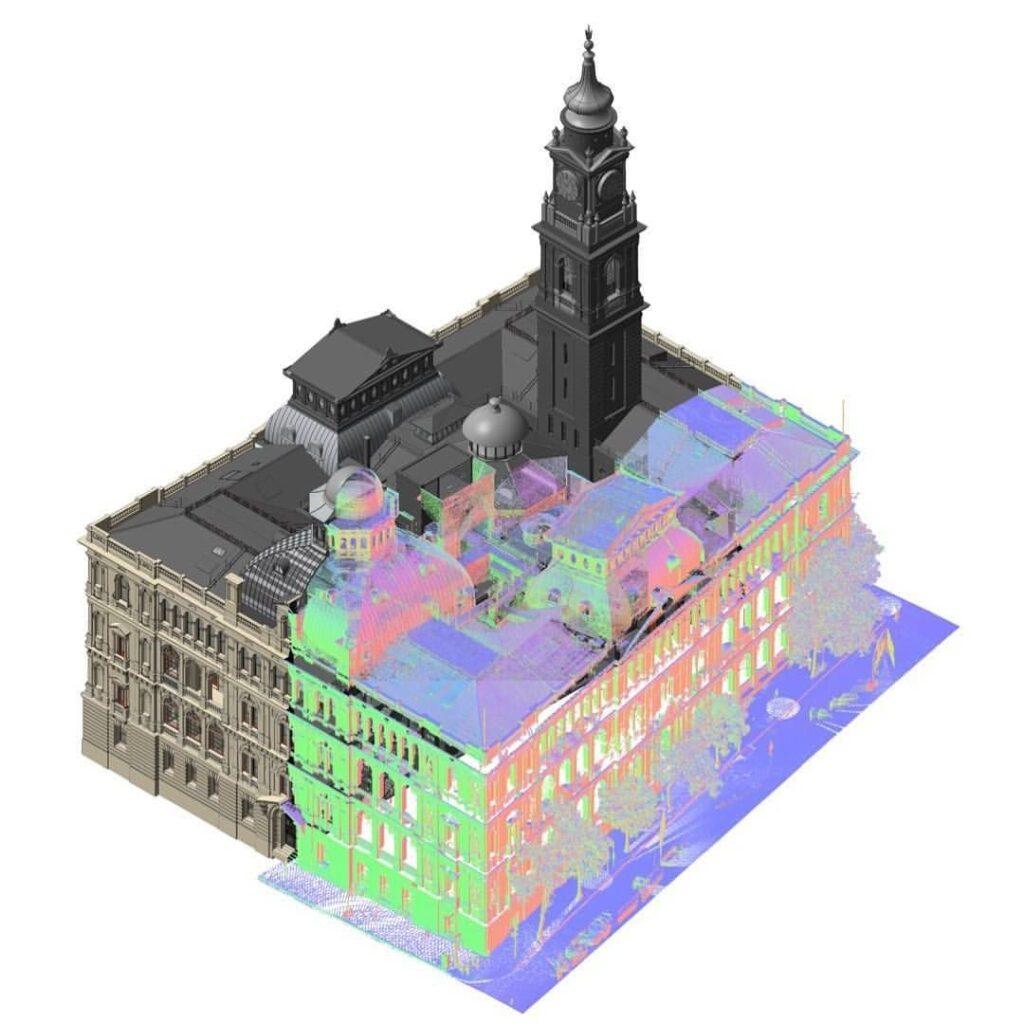
The important practical difference is that a point cloud is measured data rather than a conventional drawing. You can inspect the geometry, take dimensions and use the cloud as a reference, but it does not automatically contain clean CAD lines, wall objects, room names or BIM intelligence. Those items are created in the next stage if required.
Point Cloud Survey for AutoCAD, Revit and BIM
Point cloud data is frequently used as the measured background for design and documentation. The best workflow depends on whether your team needs the raw spatial data, traditional 2D drawings, or a model.
Point cloud only
Best when your team can work directly with scan data or when you want to preserve an accurate digital record for later use.
Scan to CAD
Best when the project needs clean 2D floor plans, elevations or sections rather than the raw cloud alone. See our Point Cloud to 2D CAD service.
Scan to BIM / Revit
Best when a 3D model is required for coordination, refurbishment, design development or BIM workflows. The required model scope and level of detail should be agreed before modelling starts.
Typical Point Cloud File Formats
The correct format should be agreed around the software and workflow used by the project team. Common deliverables include:
If you are unsure which format to request, tell us which software your architect, engineer or modeller uses. It is better to agree the delivery format before the survey than to discover later that the project team needs a different workflow.
Point Cloud Survey vs 3D Laser Scanning: What Is the Difference?
The terms are closely related but describe different parts of the job. 3D laser scanning is the capture method; the point cloud is the measured dataset produced from that capture. On many projects the phrases are used interchangeably, but defining the required output avoids confusion.
If your requirement is primarily the site capture methodology, see our 3D Laser Scanning service. If your requirement is a usable registered dataset, this Point Cloud Surveys page is the more specific service.
Not sure whether you need the point cloud, CAD drawings or a Revit model?
Send the property details and required end use. We can quote the survey and separate the optional drawing/model outputs so you only pay for what the project needs.
What Do We Need to Quote a Point Cloud Survey?
A short, clear brief helps us price the survey correctly and avoids paying for unnecessary capture or conversion work.
Property & access
Send the site address, approximate size or number of floors, and anything unusual about access, occupancy or restricted areas.
Required coverage
Tell us whether you need internal areas, external elevations, roofs, site features or only selected parts of the property.
Intended use
Let us know whether the data is for design, refurbishment, verification, coordination, as-built documentation, CAD or BIM.
Final deliverables
Confirm whether you need the registered point cloud only or additional drawings/models. Existing plans, marked-up scope drawings or consultant briefs are useful if available.
How Much Does a Point Cloud Survey Cost?
The cost depends mainly on the size and complexity of the property, access, number of scanner positions required, required coverage, data specification and whether you need only the registered point cloud or additional CAD/BIM deliverables.
Our currently published starting price for a standard residential or commercial point cloud survey in London is from £495 + VAT. Larger, more complex or more detailed projects are priced individually.
Factors that can reduce cost
- Clear access and good visibility.
- A well-defined survey area.
- Point-cloud-only delivery when no drawings are needed.
- Clear output and coordinate requirements provided before site work.
Factors that can increase cost
- Large or highly complex buildings.
- Restricted access or many separate spaces.
- Dense detail or specialist coverage requirements.
- Additional floor plans, elevations, sections or BIM modelling.
Point Cloud Survey Examples
Examples are useful because two projects with the same floor area can require very different capture strategies. Building complexity, visibility, access and the required final deliverables all affect the scope.
no images were found
Point Cloud Survey FAQ
What is a point cloud survey?
What is the difference between a point cloud survey and a measured building survey?
Can a point cloud be used in AutoCAD?
Can point cloud data be used in Revit?
What file format should I request?
Does a point cloud capture hidden surfaces?
How accurate is a point cloud survey?
How much does a point cloud survey cost?
How long does a point cloud survey take?
Can an occupied building be scanned?
Do I need Scan to CAD as well?
More Survey & CAD Services
Explore the related services below if your project needs finished drawings, a broader measured survey, topographical data or specialist laser-scanning support.
