

Accurate topographical surveys map the levels, contours and visible physical features of a site so architects, planners, engineers and developers can design from a dependable existing-site record. We tailor the survey scope to the project, from compact residential plots to complex commercial and development sites.
Ground levels, gradients and terrain needed for design and drainage.
Buildings, walls, fences, kerbs, paths, trees and other visible features in scope.
Layered topographical drawings prepared for architectural and engineering workflows.
Residential, commercial and development projects of different scales.
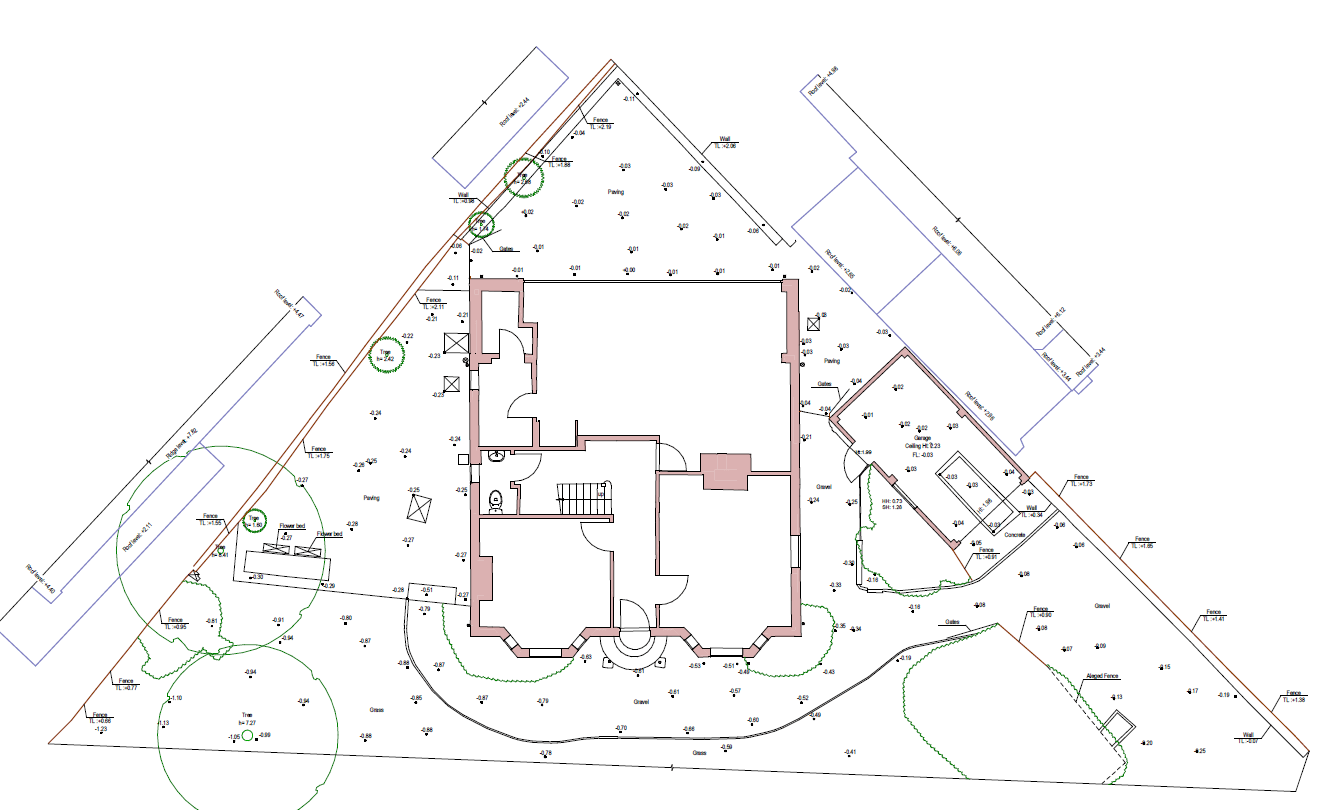
A topographical survey (also called a topographic or topo survey) is a measured record of a site’s visible physical features and levels. Depending on the brief, it can show buildings, walls, fences, kerbs, paths, trees, drainage features, spot levels, contours and other details needed by the project team.
The important point is that the survey is specified for the job. A small planning project may need a simple existing-site plan, while a larger engineering or development project may require denser levels, defined survey control, a project grid, a stated datum and more detailed feature capture.
What Do You Receive from a Topographical Survey?
The deliverables should match the decisions your architect, engineer or planning consultant needs to make. We agree the extent, level of detail and required output before the site visit so the drawing contains useful project information rather than unnecessary survey detail.
Topographical CAD drawing
A clear existing-site drawing showing the surveyed features, levels and annotation included in the agreed scope. DWG and PDF are common delivery formats.
Levels & contours
Spot levels and, where required, contours representing the shape and fall of the ground for design, drainage and site coordination.
Grid, control & datum
The survey can be related to a defined coordinate system, project grid and vertical datum where the wider project workflow requires it.
Neighbouring context
Visible adjacent buildings, roof lines, walls, access routes or other contextual features can be included where they are relevant and accessible.
3D / point-cloud data
Where laser scanning forms part of the capture, point-cloud or 3D information can be supplied if it is required by the design team.
Visible drainage features
Manholes, gullies and other visible surface drainage features can be recorded when included in the brief, with accessible levels where practicable.
What Does a Topographical Survey Show?
There is no single universal list that every project needs. A useful topo survey records the features that affect design, planning, construction or site coordination. Depending on access and the agreed specification, the survey may include:
Natural & ground features
- Spot levels, changes in level and ground gradients.
- Contours where appropriate to the site and design task.
- Significant trees, trunks and canopy information when requested.
- Hedges, planted areas and other relevant visible landscape features.
- Banks, slopes and other terrain changes important to the project.
Built & site features
- Buildings and structures within the agreed survey extent.
- Walls, fences, gates and other visible boundary features.
- Roads, kerbs, paths, hardstanding and changes in surface type.
- Steps, ramps, retaining walls and other level-critical features.
- Street furniture and visible service features required by the brief.
When Is a Topographical Survey Needed?
A topo survey provides the measured base for work that changes or relies on the existing site. It is commonly commissioned before design is fixed, so the design team can work from real levels and real site geometry rather than assumptions.
Planning applications
An accurate existing-site plan can support planning drawings and help the project team understand surrounding levels, boundaries and physical context.
Extensions & new buildings
Architects need the relationship between existing structures, site levels and surrounding features when developing proposals.
Drainage & level design
Reliable ground levels and gradients are essential when surface-water falls, thresholds, access and external works depend on the terrain.
Landscape design
Existing trees, walls, paths, level changes and site constraints provide the base information for landscape proposals.
Commercial development
Larger or more complex sites may need coordinated topographical data before concept design, engineering or construction planning.
Record of existing conditions
A dated survey provides a clear measured record of what was visible on the site at the time of capture.
Topographical Surveys, Boundaries and Utilities: What the Survey Does — and Does Not — Prove
This is one of the most important distinctions on a land or topographical survey project.
What a topo survey can record
We can measure visible walls, fences, hedges and other physical features on the ground and show their surveyed position on the drawing where they are included in the brief.
What a topo survey does not determine
A measured fence or wall should not automatically be treated as the exact legal property boundary. In England and Wales, HM Land Registry title plans generally show the general position of boundaries rather than the exact legal line.
How Does a Topographical Survey Work?
The exact method changes with the site, but a well-defined topo survey normally follows the same workflow from brief to usable CAD data.
Topographical Survey Accuracy, Control and Specification
“Accurate” should not be treated as one universal number. The required survey accuracy depends on what the data will be used for, the size and complexity of the site, the detail being recorded and the agreed control and coordinate requirements.
RICS guidance for measured surveys treats project information, survey accuracy, control, coordinate grid, datum, topographic survey requirements and deliverables as connected parts of a proper survey specification. The most useful question at the start is not “what equipment will be used?” but “what does the project need the survey to achieve?” You can read the RICS measured survey guidance for the underlying specification principles.
What should you include in a topo survey brief?
- Site address and a marked survey extent where possible.
- The project purpose: planning, design, drainage, landscape, construction or another use.
- Required features and any details that are critical to the design team.
- Whether site levels, contours or specific level information are required.
- Any coordinate system, datum, control or alignment requirement.
- Required file formats and whether 2D, 3D or point-cloud outputs are needed.
- Access limitations, occupied areas, vegetation or other constraints that may affect capture.
Topographical Survey Equipment: Total Stations, GNSS, Laser Scanning and Drones
There is no single “best” instrument for every topographical survey. The capture method should be selected around the site, the required detail, line of sight, access, vegetation, project scale and the specification.
Total station
Useful for precise observations to defined site features, levels and survey control, particularly where targeted measurements are required.
GNSS
Useful for establishing or relating survey control where satellite conditions and the project requirements make it appropriate.
3D laser scanning
Efficient for dense capture where complex structures, facades or large quantities of visible geometry form part of the survey.
Drone capture
Can be valuable for suitable open or large sites where aerial coverage adds efficiency, provided the method fits the required accuracy, access and site conditions.
Topographical Survey vs Land Survey: What Is the Difference?
“Land survey” is a broad phrase. People may use it when looking for a topographical survey, a boundary-related service, engineering survey work or another type of land measurement. A topographical survey has a clearer purpose: recording the site’s visible physical features and level information for planning, design, engineering or development.
| Search term | Typical meaning | When our topo service fits |
|---|---|---|
| Topographical survey / topographic survey / topo survey | Measured site features, levels and terrain. | Direct match for this service. |
| Land survey | Broader term that can cover several survey purposes. | Fits when the requirement is a measured existing-site/topographical plan. |
| Boundary survey | May imply a legal or ownership-boundary question. | A topo survey can record physical boundary features, but it does not by itself determine the exact legal boundary. |
| Utility survey | Detection or mapping of buried services. | Visible covers can be recorded within a topo survey; buried utility detection is a separate specialist scope. |
How Much Does a Topographical Survey Cost?
Topographical survey cost depends on the work required rather than a single fixed national price. Two plots with the same area can need very different amounts of fieldwork and processing if one is open and simple while the other has dense features, difficult access, vegetation, multiple level changes or more demanding control requirements.
- Small, clear survey extent.
- Simple feature requirements.
- Good access and visibility.
- Standard 2D CAD/PDF deliverables.
- Larger or highly detailed sites.
- Dense vegetation, obstacles or restricted access.
- More complex levels, drainage or neighbouring context.
- Additional control, coordinate or 3D/data deliverables.
Want an exact topo survey price?
Send the property/site address, approximate survey area, required outputs and any architect or engineer brief. A marked-up plan is particularly useful if only part of the site needs to be surveyed.
Choosing the Right Topographical Survey Scope
For small residential work, you may not need the same detail as a large engineering project. Instead of treating “topographical survey” as one fixed product, it is better to choose the information your project actually needs.
Boundary features & building context
Suitable where the brief mainly needs visible fences/walls, building position and straightforward site context without a full level-based terrain survey.
Full topo with site levels
Includes the agreed physical features plus level information needed for architectural, landscape or planning design.
Enhanced coordinated survey
For larger sites that need defined control, additional detail, 3D information, point-cloud data or tighter integration with other project surveys.
How to Choose a Topographical Survey Company
When comparing topographical survey companies, the cheapest headline price is not the only thing to check. A useful quote should make clear what is being surveyed and what will actually be delivered.
1. Clear survey scope
The quote should define the survey extent and the features/levels included rather than relying on the word “topo” alone.
2. Suitable deliverables
Confirm the CAD/PDF/3D formats, layers and coordinate requirements your architect or engineer needs before fieldwork begins.
3. Appropriate control
If your project needs a project grid, national coordinate reference or specific datum, make sure this is agreed at the specification stage.
4. Relevant examples
Review actual topographical survey drawings from projects similar in scale and complexity to yours rather than judging only the equipment list.
Topographical Survey Examples
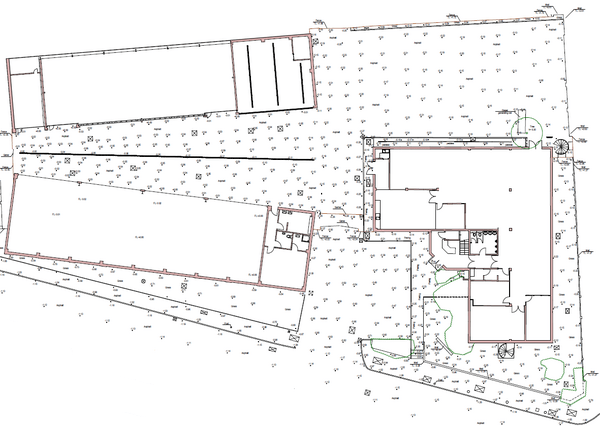
Real examples are one of the best ways to define the required level of detail. Before quoting a complex project, we can use example drawings and your design brief to agree what the final topo needs to show.


Topographical Survey FAQ
What is a topographical survey?
What is the difference between a topographical survey and a topographic survey?
What is included in a topographical survey?
Does a topographical survey show legal boundaries?
Does a topo survey include underground utilities?
How much does a topographical survey cost?
How long does a topographical survey take?
Can a drone be used for a topographical survey?
What file formats can a topo survey be delivered in?
Do I need a topographical survey for planning permission?
More Survey & CAD Services
Explore the related services below if your project also needs measured building drawings, laser scanning, point-cloud data, commercial-property capture or CAD production.
