

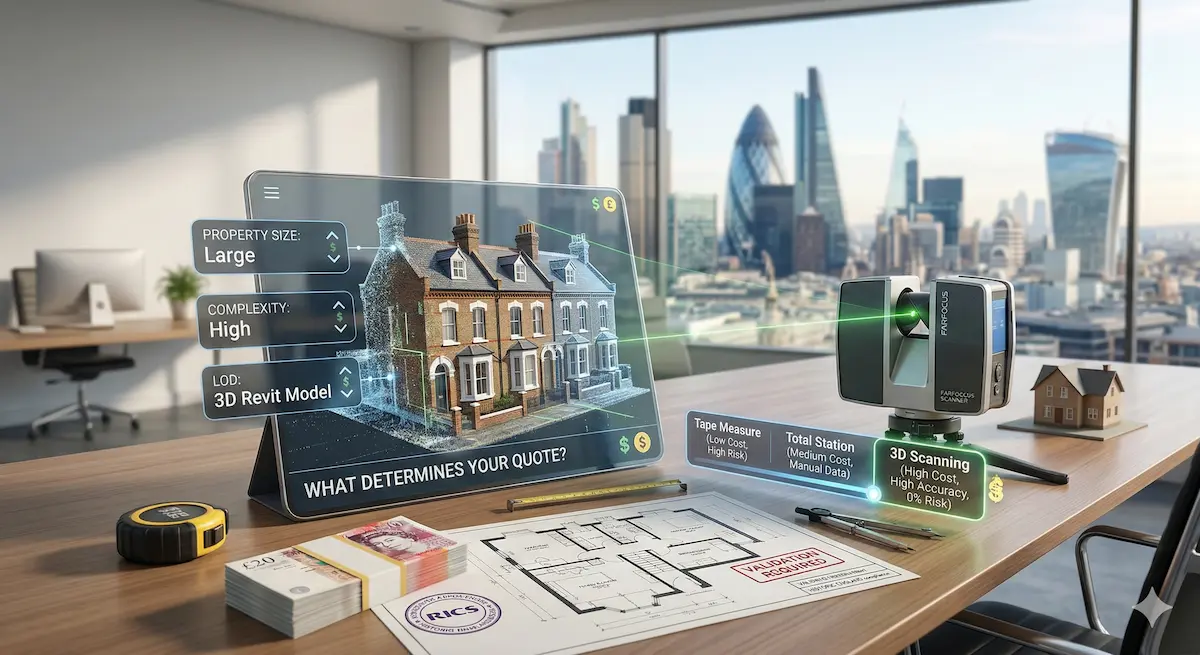
If you are planning a renovation or extension, one of your first questions will likely be: how much is a building survey? While many websites offer attractive fixed-price tables, the reality is that in the surveying industry, there are no “off-the-shelf” prices. Each project is unique in its scale, architectural complexity, and required deliverables. At Measured Survey 365, we believe in transparency, which is why we have outlined exactly what influences your quotation.
The Cost of Accuracy: Choosing Your Method
The surveying method used is the single biggest factor affecting both the quality of your data and the final price. Not all surveys are created equal:
- Tape Measure & Disto: The cheapest option, but highly unreliable due to human error and the inability to measure angles accurately.
- Total Station: A more precise manual method, yet limited by how much data can be collected in a single visit.
- 3D Laser Scanning: The gold standard. While slightly more expensive, it captures up to 976,000 points per second, eliminating human error and providing a complete “Digital Twin” of your property.
Choosing 3D laser scanning often saves money in the long run by preventing costly construction errors and the need for site re-visits.
5 Key Factors Influencing Survey Costs in London
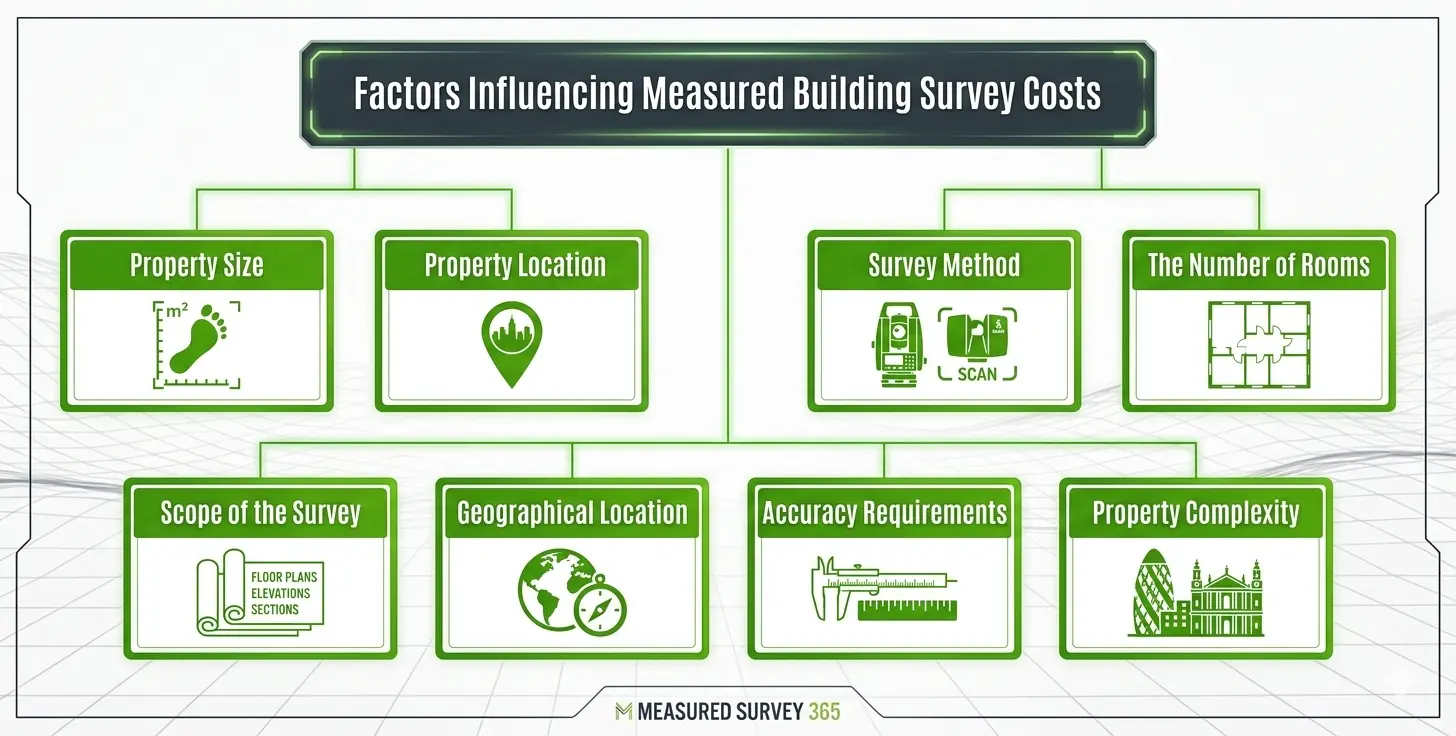
When we prepare a bespoke quote for a measured building survey in London, we evaluate several technical criteria:
1. Property Size and Layout Complexity
It is not just about total square footage. A large open-plan warehouse is often cheaper to survey than a smaller, highly partitioned Victorian house. We calculate the number of “scans” required—typically 3 scans per room are needed to ensure full coverage without “blind spots.”
2. Level of Detail (LOD)
Are you looking for basic floor plans for a planning permission application, or do you need highly detailed internal elevations and reflected ceiling plans? The more detail required, the more time our CAD technicians spend drafting your project.
3. Geographic Location & Logistics
Projects in Central London incur additional costs such as Congestion Charges, ULEZ fees, and high parking rates. Surveyors in remote areas of the UK may also charge a premium due to travel time and lack of local competition.
4. Building Type: Heritage vs. Modern
Surveying a listed building with ornamental features and irregular walls takes significantly longer than a modern glass-and-steel commercial unit.
5. Site Conditions
Empty properties are easier and faster to scan. High levels of furniture, clutter, or operational machinery in warehouses can increase the time needed on-site to capture a clean dataset.
Average Prices: London vs. UK
While we advise against relying on generic estimates, current market benchmarks provide a baseline:
- UK Average: Basic small-scale projects outside major hubs start from approximately £350 + VAT.
- London Average: Due to logistical complexity and dense architecture, a standard professional survey typically starts from £495 + VAT.
Top 3 Tips to Lower Your Surveying Fees
- Be Specific with the Brief: If you only need floor plans, don’t ask for a “full survey.” Excluding unnecessary elevations can significantly reduce the cost.
- Provide Existing Plans: Even outdated marketing plans help us understand the complexity of the layout, allowing for a more accurate and often lower quote.
- Parking & Access: If you can provide a parking permit or guaranteed space for the surveyor’s van, mention it! This can save up to £100 in logistical allowances.
Get a Fixed-Price Quote in 30 Minutes
Don’t rely on guesswork. Provide us with your property address, and we will review the site via Google Maps to give you a precise, transparent quotation today. Request your free quote now.
