

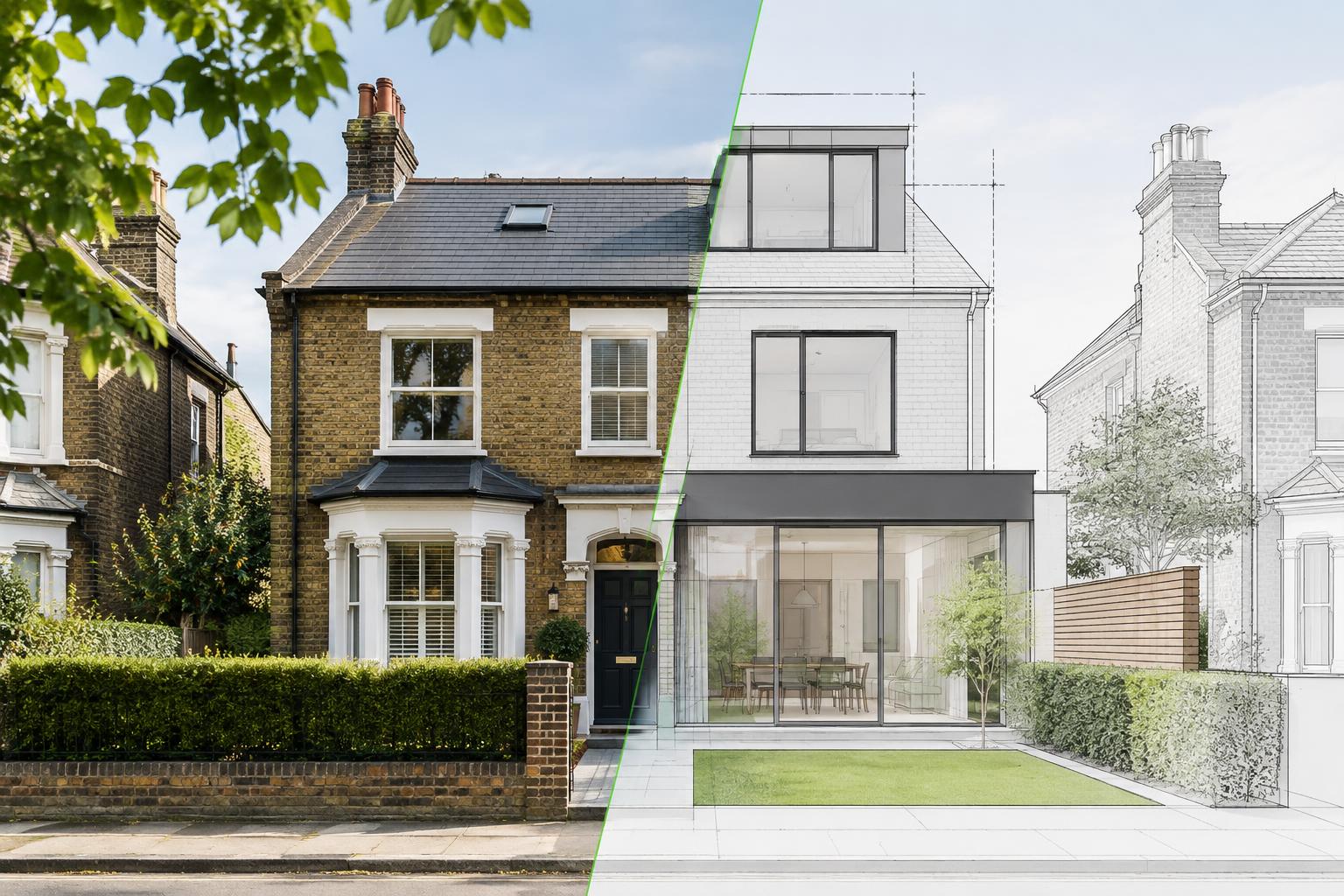
Before producing a planning set, establish which legal route applies. The answer can depend on property type, dimensions, designated land, Article 4 directions and earlier planning conditions.
Permitted development and planning permission are different routes
They are often discussed as if one is a “smaller” version of the other, but legally they work differently. A normal planning application asks the Local Planning Authority to decide whether the proposed development is acceptable. Permitted development rights already grant planning permission nationally for specified development, subject to detailed rules.
| Route | What you are relying on | Typical outcome |
|---|---|---|
| Planning permission | A site-specific decision by the Local Planning Authority. | Permission may be granted, refused or granted subject to conditions. |
| Permitted development | A right in the General Permitted Development Order, provided all relevant conditions and limitations are met. | No normal planning application is required for that development, although another procedure may still apply. |
| Prior approval | A permitted development class that requires specified matters to be checked by the authority before work proceeds. | The authority decides only the matters defined by that route. |
| Lawful Development Certificate | A formal legal determination that existing or proposed development is lawful for planning purposes. | A certificate if the legal test is satisfied; it is not the same as planning permission. |
What can stop permitted development applying?
Permitted development is conditional. A project can look similar to another property nearby and still have a different answer. Relevant factors can include the type of property, previous development, dimensions, location, design details and whether rights have been restricted.
- The property is a flat or maisonette. The common householder rights in Part 1 apply to houses, not flats.
- The site is in designated land. Some rights are more restricted in conservation areas and other Article 2(3) land.
- An Article 4 direction applies. A Local Planning Authority can remove specified permitted development rights in an area.
- A planning condition removed rights. Earlier permissions can restrict development that might otherwise be permitted.
- The proposal exceeds a limit or misses a condition. Dimensions, position, materials, windows, roof form and other criteria can determine the result.
Prior approval is not the same as full planning permission
Some permitted development classes include a prior approval process. A familiar householder example is the neighbour consultation scheme for larger single-storey rear extensions. The proposal still has to satisfy the underlying permitted development rules, and the authority considers the matters specified by that procedure rather than carrying out the same assessment as a full planning application.
When a Lawful Development Certificate can be useful
If a proposal appears to fall within permitted development but you want formal evidence of lawfulness, you can apply for a proposed Lawful Development Certificate. GOV.UK explains that the authority considers whether the proposed operation would be lawful if it started on the application date. A certificate can be particularly useful where a future buyer, lender or professional adviser may want formal planning evidence.
An LDC is not a general approval of design quality and it does not replace Building Regulations or other consents.

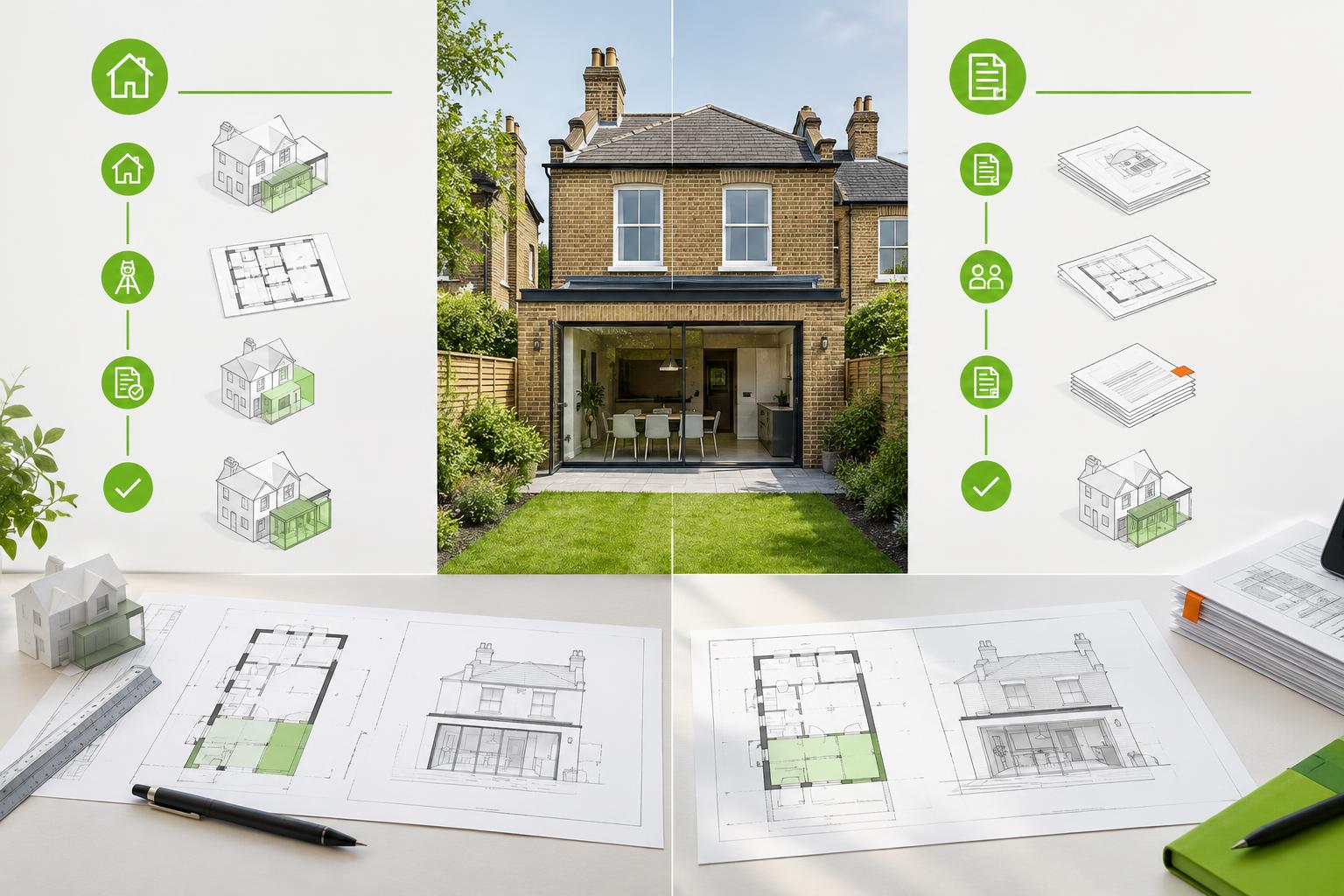
A practical route-checking sequence
Planning is separate from other approvals
A project that does not need a normal planning application can still need Building Regulations approval. Listed building consent, Party Wall procedures, lease or freeholder consent and other legal requirements are also separate questions. GOV.UK explicitly notes that Building Regulations approval is different from planning permission and a project may need both.
Related planning guides
FAQ
Does permitted development mean I can start work immediately?
Not always. Some permitted development classes require prior approval, and other consents may still be needed. Check the exact class and the current rules before starting work.
Does a conservation area automatically remove all permitted development rights?
No. Restrictions depend on the class of development and any local Article 4 direction. Some householder rights are reduced on Article 2(3) land, while others may still be available subject to their own conditions.
Is an LDC the same as planning permission?
No. An LDC confirms lawfulness for planning purposes; it is not a discretionary planning permission.
Official sources
Official guidance checked on 22 September 2026. The links below should be checked again when you use this article because rules and local requirements may change.
- When is permission required? — GOV.UK / MHCLG
- Permitted development rights for householders: technical guidance — GOV.UK / MHCLG
- Lawful development certificates — GOV.UK / MHCLG
- Building regulations approval: when you need approval — GOV.UK
